We Built 100+ Financial Skills. Here's What That Means for Your Firm.
By Jon Edward Santillan, Co-Founder & CEO, OCTA
OCTA Flow ships with 100+ financial skills your firm can run today. A skill is a documented accounting procedure that knows how to execute itself, so your team reviews the output instead of doing the work by hand.
We built 100+ financial skills that your firm can use today. Here is what that actually means. Not AI-powered workflows. Not intelligent automation. A skill is a procedure, the same procedure a senior accountant follows, encoded so it can run itself. The firm stops being the checklist. The firm reviews the output.
That distinction matters more than any other claim we could make, so let us show you exactly what it looks like in practice.
What Is a Skill?
In OCTA Flow, a skill is a documented accounting procedure that knows how to execute itself. It knows what inputs it needs: a bank statement, a GL export, a prior-period reconciliation. It knows what to check: unmatched transactions, stale outstanding cheques, unrecorded bank charges. It knows what evidence to collect. It knows what to flag, what to escalate, and what requires partner sign-off. When it finishes, it produces a structured output, not a draft and not a summary, but a workpaper that is ready for review.
The accountant's job shifts from doing the procedure to reviewing what the procedure found. That is the whole model: one skill, one procedure.
We have over 100 skills covering reconciliation verticals, payroll taxes across 30+ jurisdictions, VAT and GST returns across 25+ countries, revenue recognition, trial balance review, journal entry testing, and more. Every card is a complete procedure: what to check, what evidence to collect, what to flag, and what output to produce.
Here's One We Made: Bank Reconciliation
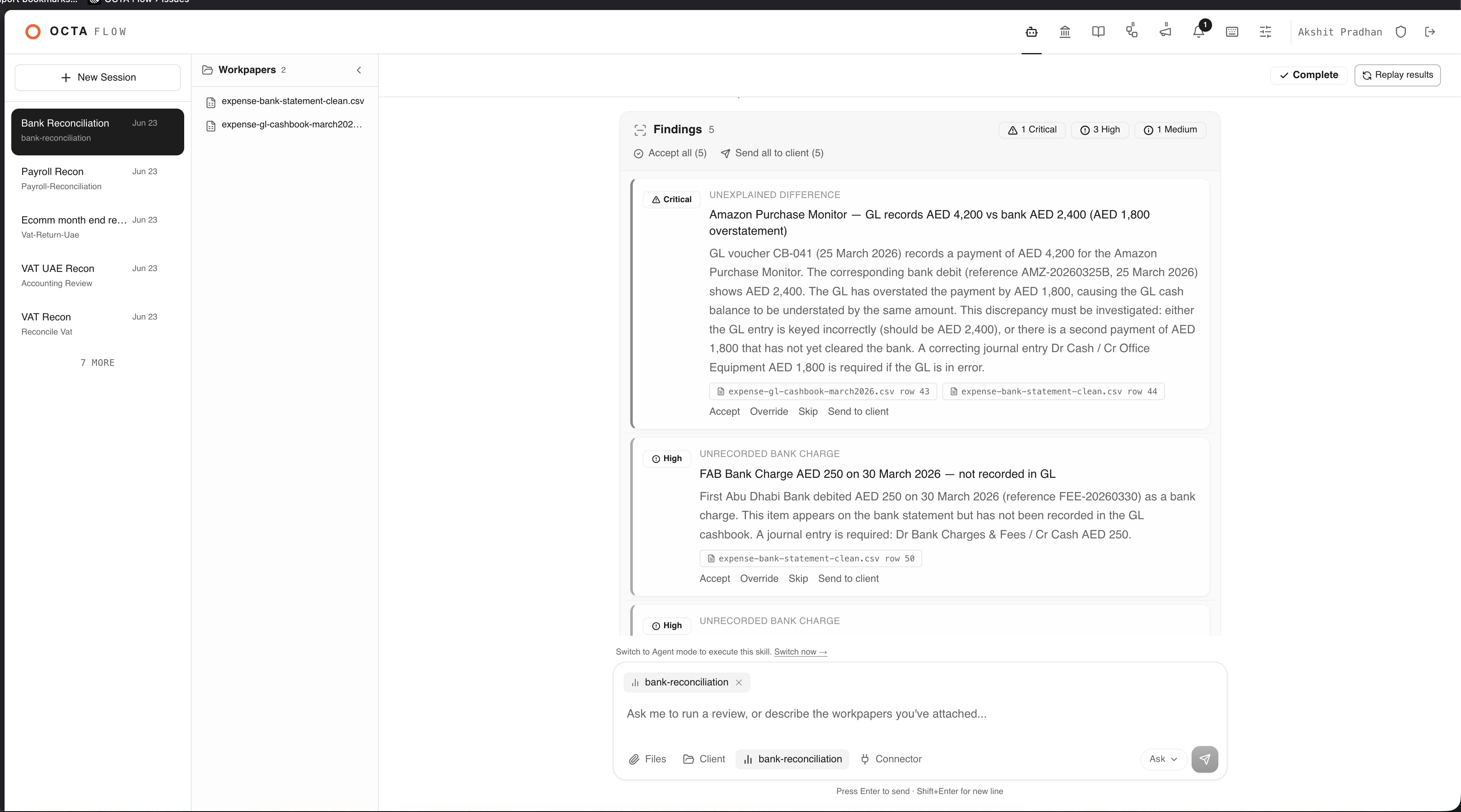
The bank rec is the most universally understood piece of month-end close work. Every accounting firm does it, and every firm knows how much time it takes. Here is what OCTA Flow's bank reconciliation skill actually does when you run it.
- It reads every file: The skill ingests the GL cash account detail (CSV or XLSX), the bank statement data feed, and the official bank statement PDF. It maps them to their roles before analysis begins, so it does not matter what your client named the export.
- It matches transactions: Every GL cash entry is compared against every bank transaction. The matching window is plus or minus 3 days, the standard for timing differences. Matched items are confirmed, and everything else becomes a reconciling item.
- It categorizes what it found: Outstanding cheques, deposits in transit, bank charges not yet recorded in the GL, and GL entries that have no business being there. Each category has a defined set of actions (resolve, escalate, void and reissue, email vendor) and a recommended default, so the reviewer never starts from a blank slate.
- It flags edge cases automatically: Cheques outstanding more than 90 days (stale cheque risk). NSF returns (customer credit risk). Wire transfers near period end with no clear business purpose. Duplicate transaction amounts on the same date. The skill looks for the things a distracted junior misses at 10pm.
- It carries forward prior-period items: If the prior-period reconciliation is available, outstanding items from last month are checked against this period's bank statement. Items that should have cleared but have not are surfaced automatically.
- It proposes the journal entries: For every unrecorded bank charge or credit, the skill produces the exact journal entry: debit account, credit account, amount, and narration. The accountant approves or edits. They do not draft from scratch.
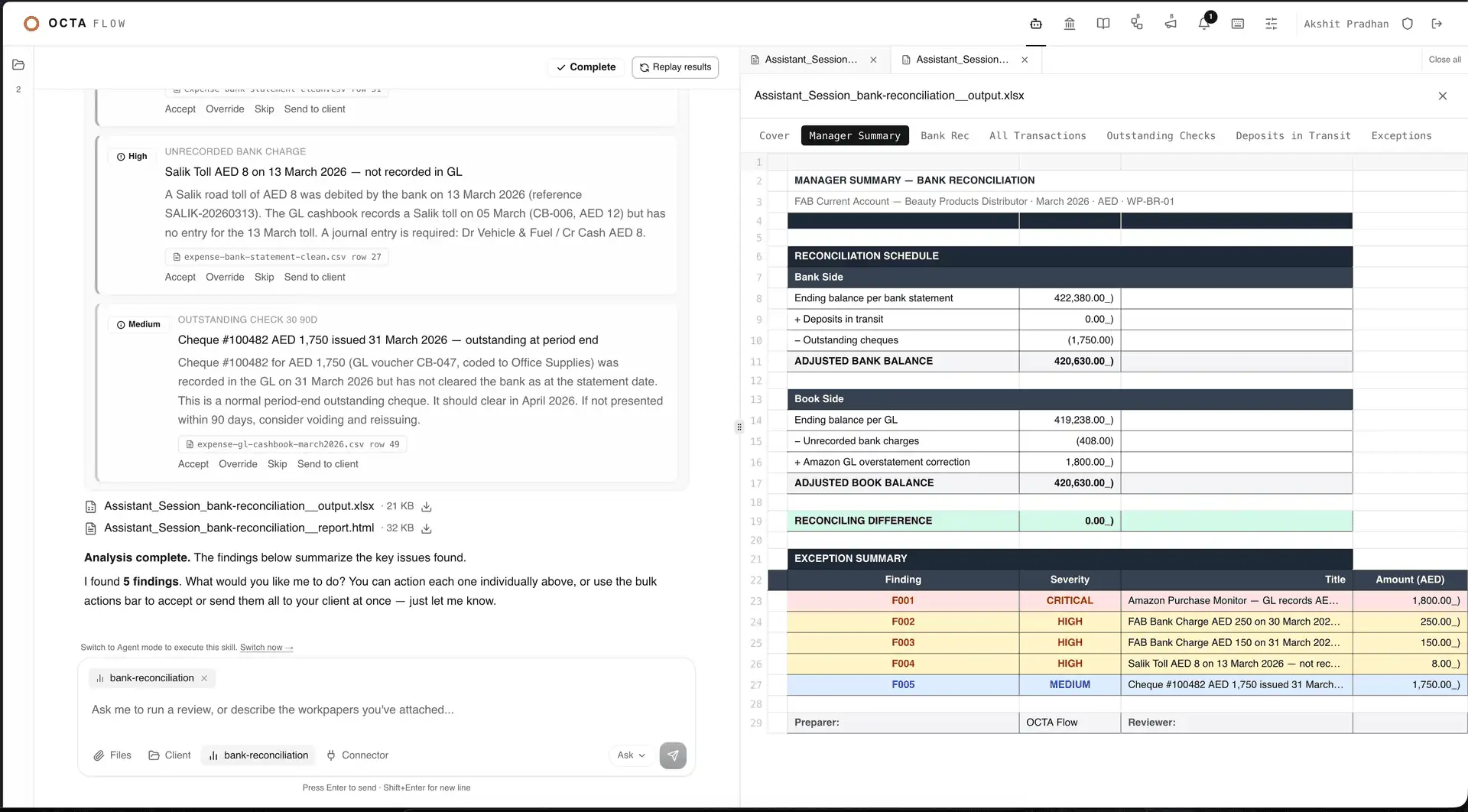
The output is a seven-tab Excel workpaper: Manager Summary, Bank Rec schedule, All Transactions register, Outstanding Cheques, Deposits in Transit, and Exceptions. Each tab is built from structured data, formula-driven, and ready for the partner to sign.
From hours to a quick review We used to spend between two and four hours on every bank rec depending on the client. OCTA Flow reduces that to the time it takes to review the output.
Here's How to Build Your Own
Every firm runs different software. Your clients are on Xero, QuickBooks, Sage, bespoke ERPs, or some combination of all four across different jurisdictions. The pre-built skills work with any of them. But sometimes your firm's procedure is specific to your clients' setup in a way that no generic skill covers.
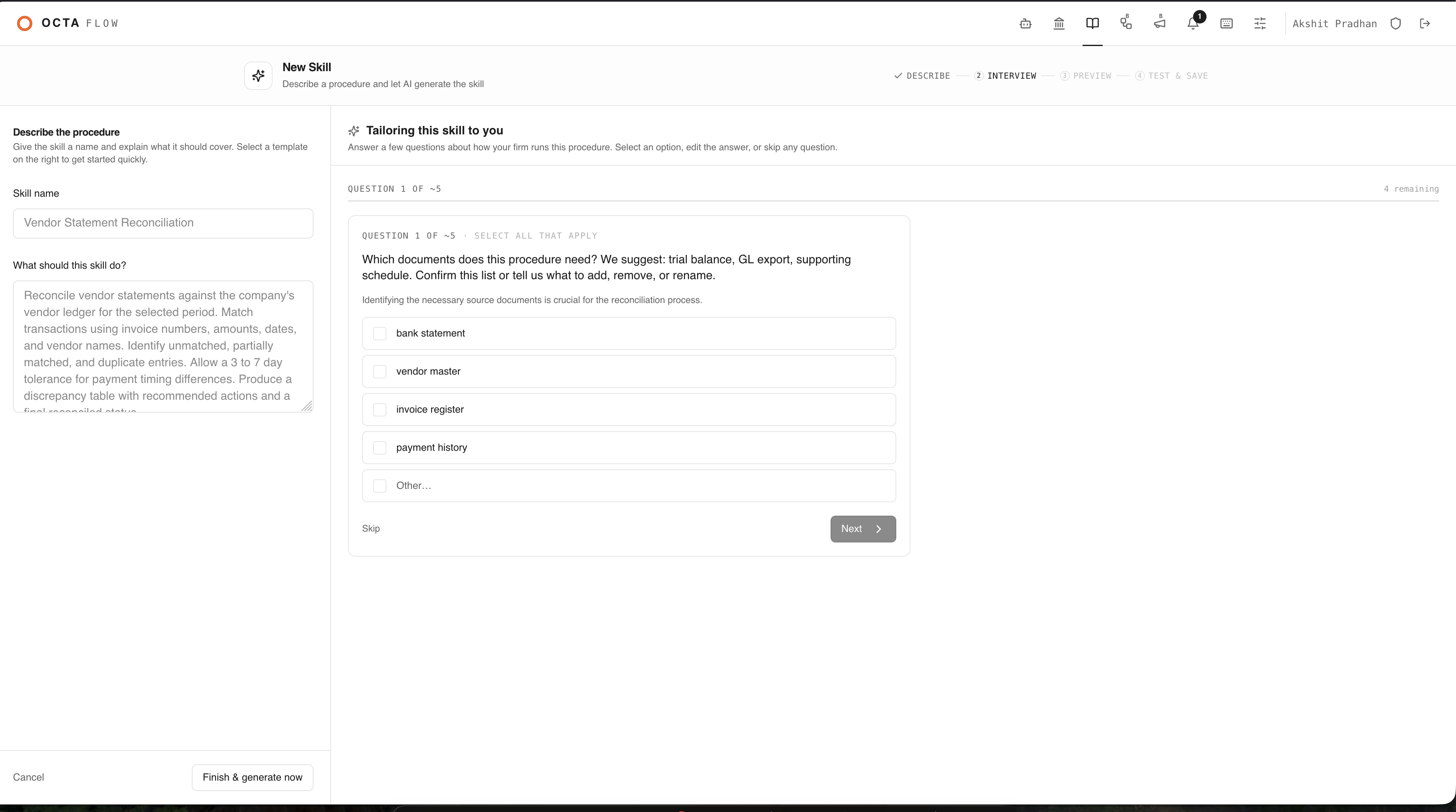
OCTA Flow lets you author a custom skill without writing any code. You describe the procedure in plain words, and OCTA's AI interviews you, a handful of questions, to lock down the details: what documents it needs, what to check, and what to flag. Then it previews and tests the skill before you save it. Let us use the hardest version, so your own use case feels straightforward by comparison.
Scenario: multi-provider, multi-jurisdiction intercompany reconciliation A group entity has four subsidiaries: UK on Xero, UAE on Sage, India on a bespoke ERP, and US on QuickBooks. Each entity books intercompany transactions in its own functional currency, and the group consolidates in USD. Before consolidation, intercompany receivables and payables across all six entity pairs need to agree.
The skill definition for this scenario captures four things.
- What inputs it needs: Group structure (entity names, functional currencies, ownership percentages). IC receivable and payable balances per entity pair. Period-end and average exchange rates. Transaction-level detail for unreconciled pairs.
- What procedure it follows: Map the group, load exchange rates, and translate every IC balance to the consolidation currency. Compare each pair, Entity A's receivable from B against B's payable to A. Identify differences: in-transit items, FX translation differences, unrecorded charge-backs, incorrect entity codes. Drill into transaction detail for unresolved pairs, produce elimination journal entries for reconciled pairs, and document everything else.
- What it flags: Pairs with differences above the tolerable threshold. IC differences that have persisted from prior periods. Unrealized intercompany profit sitting in inventory. Entities booking IC balances to counterparties outside the group.
- What actions are available: IC balance mismatch: email counterparty, escalate, request approval. Elimination entry missing: record elimination, escalate. FX translation difference: resolve, override, escalate.
During the interview, OCTA confirms the inputs the procedure needs. It suggests a starting list, and you accept, rename, or add to it, so the skill knows exactly what to ask for before it ever runs:
| Input role | Format | Required |
|---|---|---|
| group_structure | JSON | Required |
| ic_receivable_payable | CSV or XLSX | Required |
| exchange_rates | JSON | Optional |
| intercompany_transactions | CSV | Optional |
If you can define the procedure in plain language, OCTA Flow can execute it. The skill definition is the documentation your team would write anyway. It just runs.
Try It on Your Next Bank Rec
Every firm that signs up to OCTA Flow gets access to all 100+ skills on day one: bank reconciliation, payroll tax computations, GST and VAT returns, intercompany reconciliation, trial balance review, and revenue recognition. The full library, ready to run on your next engagement. If you're also evaluating how the broader landscape of AI finance platforms compares, see our editorial ranking of the best AI finance automation platforms of 2026. To understand the agentic AI shift underpinning this model, From Chatbots to AI Agents: The Next Frontier in Finance Automation covers the architecture in plain terms.
- Upload the files: No integrations to configure before you start.
- Select the skill: Pick from the full library of 100+ procedures.
- Review the output: A workpaper ready for partner sign-off.
Get access to OCTA Flow You do not need to build anything, and you do not need to configure integrations before you start. No friction, no sales call. The skills are there when you log in. Get access to OCTA Flow